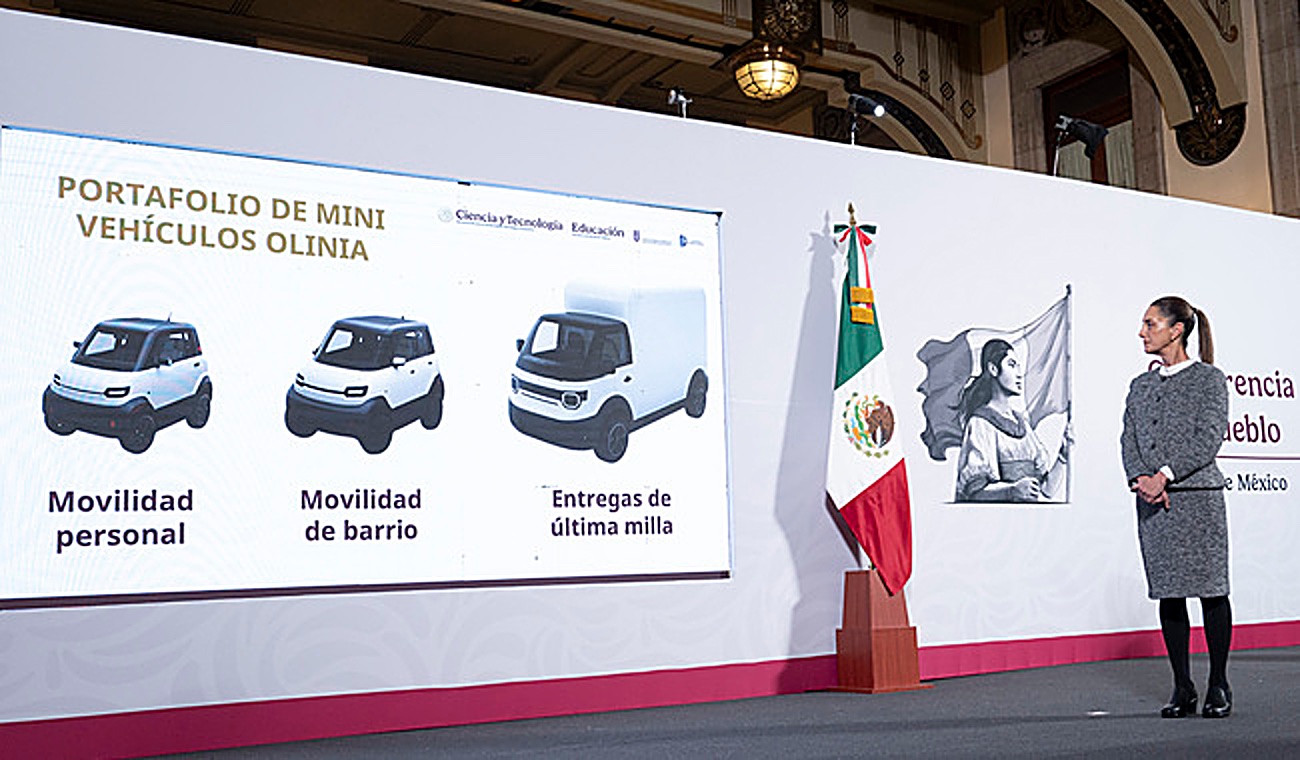
The President of Mexico, Claudia Sheinbaum, has announced her intention to launch an assembly plant for small electric vehicles developed in Mexico. The project will be financed by public and private capital. The first vehicles should be available by the end of her term in 2030. The aim is to offer a sustainable, efficient and affordable urban mobility solution to millions of Mexicans, given that 70% of the population lives in urban areas.
A project called “Olinia”
Named “Olinia” – meaning “movement” in Nahuatl, an indigenous American language – the project provides for safe, electric vehicles that can be recharged from any socket. Most of their components will be manufactured locally. A Mexican production chain will gradually be developed.
Three types of vehicle planned
- Individual mobility: Designed for young people, for parents taking their children to school, and as a safer alternative for those considering buying a motorcycle.
- Neighborhood mobility: Intended to replace today's “mototaxis”, these vehicles will offer a quieter, more comfortable and safer option for users, while being more economical for drivers.
- Last-mile deliveries: Designed to meet the growing demand for deliveries in online commerce, these vehicles will be an affordable and efficient alternative.
A competitive price
The vehicles will be sold for between €4,000 and €7,000, depending on the model, with fair financing plans that will make electric mobility accessible to all Mexicans.
A partnership between government, academia and business
The project will be coordinated by the Ministry of Science, Humanities, Technology and Innovation and developed by the National Polytechnic Institute (IPN) and the National Technological Institute of Mexico (TecNM), which will receive an initial budget of 25 million pesos (around 1.2 million euros) in 2025 to start the project.
One of the innovative aspects of the project lies in the link between the academic, government and industrial sectors. While Mexican engineering schools have already designed prototypes of small vehicles, this is the first time a large-scale production project has been envisaged. Private companies will be invited to take part, particularly in the production of electric motors, a field in which some of them have already acquired expertise.
A modular platform
The vehicles will be based on a versatile modular platform that brings together chassis, motor, transmission and battery, developed once only. Specific bodies will then be adapted to each use.
Challenges for local production
While some components, such as batteries, will initially be imported, Mexico has lithium reserves in the north of the country. However, mining them is complex and costly because of the presence of clay. Research programs are under way to optimize extraction techniques.
Regional assembly and distribution
To keep costs down, regional assembly plants will be created, making it possible to produce and distribute the vehicles locally. This will avoid high transport costs, making the vehicles more affordable.
A favorable ecosystem
At the same time, the IPN will help to create an ecosystem favorable to the development of electric vehicles. Market analysis, a business plan and a preliminary design for light vehicle plants will be carried out through the Tecnópoli Directorate of Foresight and Intelligence of the IPN's Ministry of Innovation and Social Integration.